无心法师
对于Google Chrome OS:brydge发布桌面键盘和触摸板_我的网站

A |
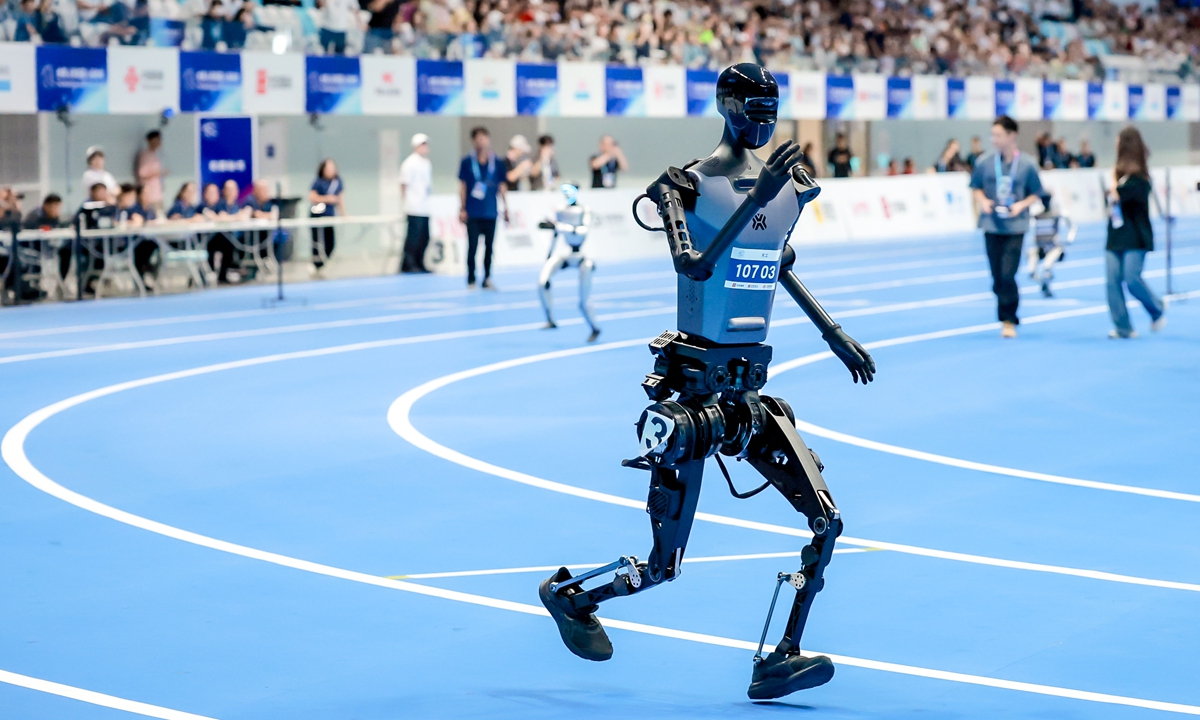
A TienKung robot competes at the first World Humanoid Robot Games. File photo: Courtesy of X-HumanoidWith the 2nd World Humanoid Robot Games (WHRG) set to open on Saturday in Beijing, organizers have unveiled a dedicated "Robot Home" to ensure that the mechanical athletes are fully charged and competition-ready.
The Games, to last until August 26, are drawing 666 teams and 2,056 robots from 16 countries and regions across six continents, underscoring the event's growing scale and influence in the global humanoid robotics sector, according to Chinese industry experts on Sunday.
A key feature this year is the newly established "Robot Home," an on-site support center designed to function much like an athletes' village for human competitors.
The facility can house more than 1,500 robots and charge at least 1,200 batteries, while enabling digital check-in and retrieval for a single robot in just 30 seconds, according to reports by China Central Television (CCTV) Finance on Sunday.
This marks a clear shift from a simple technology showcase to a more mature, competition-grade event, one analyst said. With robots now being managed through systems similar to industrial asset management - covering storage, dispatch, maintenance and safety monitoring - the Games are increasingly seen as a practical testbed for the commercialization of humanoid robotics.
According to CCTV Finance, the Robot Home will act as the football training and competition base for robots.
For team events like football, the organizing committee often provides the robot bodies, and just a few steps away is the energy recharging station.
At the station, the batteries offered by the organizing committee are charged in advance in the power cabinets, with each compartment equipped with a corresponding power strip.
The Games will also feature a "Robot Street," with activities such as intelligent retail, virtual reality viewing, and robot-operated cafes, providing a richer technology experience for both participating guests and spectators.
It will also provide an interference-resistant and highly reliable competition environment, achieving 5G+Wi-Fi converged communications.
According to the CCTV report, the event organizer has also developed the world's only competition command system specifically designed for robot events, along with an embodied intelligent robot management platform that enables the management of robots across different brands and models.
An analyst said the focus of this year's Games is shifting from whether robots can finish a course to whether they can actually perform tasks.
"Last year it was about whether they could run to the finish line. This year it's about whether they can get the job done," Wang Peng, an associate research fellow at the Beijing Academy of Social Sciences, told the Global Times.
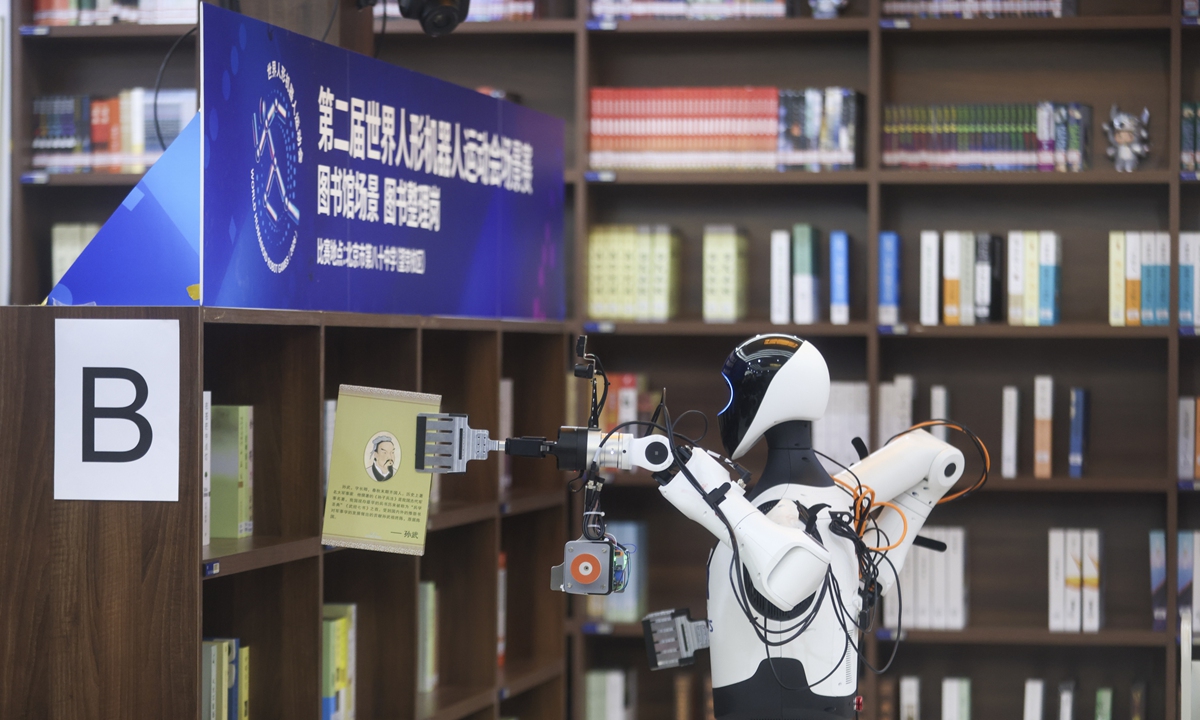
A humanoid robot inspects a bookshelf during a library scenario competition at the 2nd World Humanoid Robot Games in Beijing on August 16, 2026. Photo: VCGSome scenario-based events began their preliminaries on Sunday.
Centered on real-world applications, the scenario competition, one of this year's highlights, is designed around practical needs, with long-process tasks built on complete business logic to test humanoid robots' coordination and operational capabilities in real, complex environments, according to the organizers.
At a real firehouse in Beijing on Sunday, humanoid robots took part in a simulated firefighting mission, testing their ability to detect hazards, operate equipment and respond to emergency scenarios.
Meanwhile, several participating teams were seen in the final sprint of preparation, gearing up for competitions across diverse scenarios such as home services, industrial manufacturing, and emergency rescue.
At the industrial ecosystem training and evaluation base inside the National Speed Skating Oval, robots entered intensive preparation for office-scenario events.
In one challenge, robots must autonomously complete tasks such as loading printers, arranging meeting supplies and operating a paper shredder within 20 minutes. Any mistake or delay can affect the final score, staff at the venue explained.
Compared with the inaugural edition, the number of participating teams has increased by 138 percent, underscoring the rapid expansion of humanoid robotics as the technology moves from showcase demonstrations toward practical application.
This year's Games will run for five days and feature 51 events in total, including 30 competitive events such as ball games and confrontation contests, as well as 21 scenario-based events covering industrial assembly, home services and emergency rescue.
The planned 51 events span competitive, scenario-based and dexterous hand categories, which will reflect gains in motion control, perception-based decision-making and fine control, Chen Jing, a vice president of the Technology and Strategy Research Institute, told the Global Times on Sunday.
The competition has been significantly expanded in both scale and realism.
Scenario-based contests will take place in environments modeled on factories, hotels, homes and logistics facilities, with tasks including assembly, housekeeping, rescue operations and book sorting designed to test robots' ability to perform useful work in demanding conditions, according to reports from the Xinhua News Agency.
For the first time, the Games will establish a dedicated dexterous hand competition, which includes eight high-precision events, all drawn from real industrial production and everyday life scenarios.
A representative from AGILINK, the officially certified dexterous-hand equipment provider, told the Global Times on Sunday that winning the dexterous hand competition certifies a product's capability and means it has cleared the "demonstration-grade" threshold for real-world use.
The event is better understood as an incubator of industry consensus, Chen said, adding that competition first identifies the testing methods that Chinese and foreign firms both accept, which can then evolve toward international standards.
With robots now being managed through systems resembling industrial asset management, including storage, dispatch, maintenance and safety monitoring, the Games are increasingly seen not merely as a technology exhibition, but as a practical testing platform for the commercialization of humanoid robotics, according to Wang.
As the competition opens, the key question may be less about who wins medals and more about which robots, and which companies behind them, will be able to turn those medals into marketable orders, Wang noted.
。1月10日:据9至5日谷歌的消息,在谷歌的像素板正式亮相前一个月,布莱奇发布了一款由谷歌平板电脑制造的第三方配件。

B | 虽然G-TYPE已经发布了一段时间,但没有一家制造商在CES 2019之前正式推出其设备。本周,Brydge宣布推出“首款专门针对谷歌Chrome OS的桌面键盘和触摸板”。代号为Goanna的无线桌面键盘于10月份泄漏。它与PixelSlate的午夜蓝颜色相匹配,带有专用的ChromeOS功能键、后退按钮、刷新、全屏和多任务处理。其他功能键包括屏幕亮度、播放/暂停、音量和菜单。键盘使用蓝牙4.1,电池可以使用6个月,背面还有一个USB-C接口,这就是布莱奇所说的“双重连接”。同时,在左下角的ctrl旁边是google智能助手键。

C | 键盘的机身是铝制的,略微向用户倾斜,符合人体工程学。它将提供美国和英国以及德国的英文布局。除了键盘,布莱奇还推出了一款“无线桌面触摸面板”,它使用了类似的铝制机身。表面由玻璃制成,滑动顺畅,多点触摸手势支持,与其他彩盒相似。它宽5.5英寸,高3.3英寸。它配备了蓝牙4.2。它通过USB-C连接,持续6个月。这两款ChromeOS配件将于早春预购,并于春季末以99美元(671元)的价格发货。

D |
Current article:http://det.suilaoheirenzhaizhaikang.sbs/j128d/20260826/259.html
Published on:21:33:56